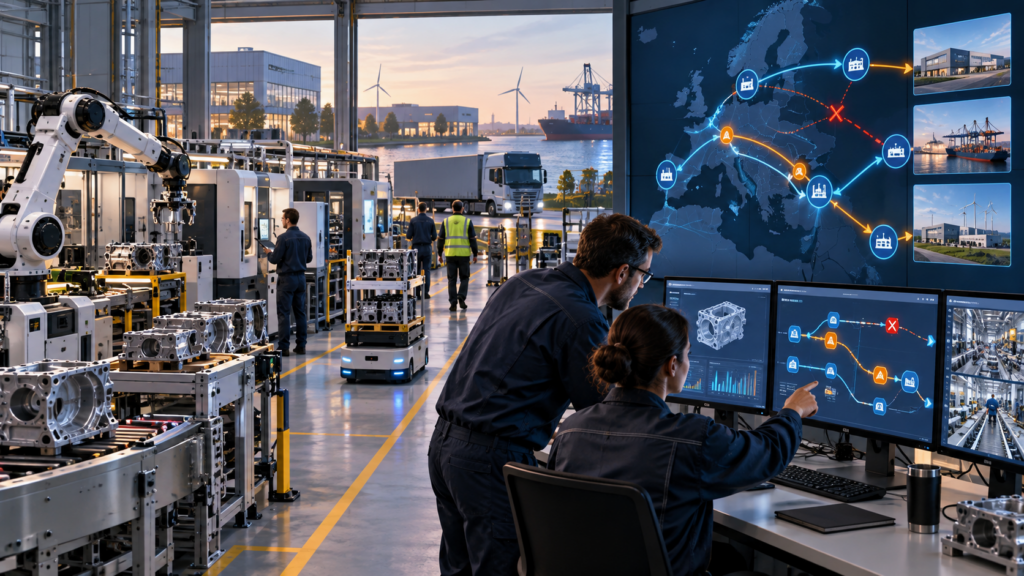
Robust technology is designed to resist expected variation. Resilient manufacturing goes further: it gives an organisation the ability to anticipate disruption, absorb its effects, adapt operations, recover and learn.
A machine that continues to operate within a defined temperature range is robust. A production system that can detect a material shortage, evaluate alternatives, reconfigure its schedule, guide the workforce and recover without losing control is resilient.
The distinction matters. Robustness is the ability to withstand expected stress without significant change. Resilience includes the ability to anticipate, absorb, adapt, recover and learn when conditions exceed the assumptions for which the system was designed.
Modern manufacturing needs both—but buying more robust equipment alone will not create a resilient enterprise.
Disruptions travel across system boundaries
A factory can have highly reliable machines and still be vulnerable. A missing electronic component can stop an assembly line. A cyber incident can make healthy equipment unavailable. An energy constraint can invalidate the production plan. The absence of one specialist can delay recovery because essential knowledge was never documented.
These effects cross technical, organisational and supply-chain boundaries. Resilience must therefore be considered at several connected levels:
— Asset: Can equipment fail safely, reveal its condition and be restored efficiently?
— Production system: Can routes, sequences, recipes or resources be reconfigured?
— Information system: Are critical data and services available, secure and recoverable?
— Organisation: Are responsibilities, skills and decision rights clear during disruption?
— Value network: Can partners exchange trustworthy information and coordinate alternatives?
Optimising any one layer while ignoring the others can shift vulnerability rather than remove it.
Visibility must lead to options
Manufacturers have invested heavily in monitoring. Visibility is valuable, but a dashboard does not create resilience by itself. Once a disruption is detected, the organisation needs feasible response options and the authority to act.
This is where digital and physical flexibility meet. Standardised asset information can show which machines have compatible capabilities. A digital twin can test a revised production sequence. Industrial AI can identify emerging anomalies or support scenario evaluation. Flexible automation can execute a new route. Skilled people can judge consequences that were not represented in the model.
The technologies are enablers. Resilience comes from the complete decision-and-action loop.
Efficiency and resilience are not opposites
Resilience is sometimes equated with expensive redundancy. Strategic buffers and backup capacity can be appropriate, but resilience also comes from information quality, modular architectures, interoperability, cross-trained teams and faster reconfiguration.
The right question is not whether every risk should be eliminated. That is impossible. The question is which capabilities reduce the impact and recovery time of the disruptions that matter most.
A resilience case can therefore be evaluated through indicators such as:
— time to detect a deviation
— time to reach a coordinated decision
— time to recover an acceptable level of output
— availability of alternative resources or routes
— proportion of critical knowledge accessible beyond one person or system
— learning actions completed after an event
These measures connect resilience investment to operational performance.
Human-centred design is a resilience mechanism
The European Commission’s Industry 5.0 framing places resilience alongside sustainability and human-centricity. These priorities reinforce one another. People who understand the system, receive meaningful information and can intervene safely are a source of adaptability. Systems that overwhelm operators with alarms or remove context from automated decisions can become less resilient even if they are technically advanced.
Good design defines when automation acts, when it asks for confirmation and how people regain control. Training, simulation exercises and post-event learning should be treated as part of the system architecture.
Design for change, then practise it
A practical resilience programme begins with a small number of consequential disruption scenarios. For each scenario, the organisation maps dependencies, detection mechanisms, decision rights, response options and recovery criteria. It then tests the response through simulation, a tabletop exercise or a controlled pilot.
The purpose is not to predict every future event. It is to build adaptive capacity that remains useful when the exact disruption is unfamiliar.
Robust technology helps a factory resist. Resilient manufacturing helps the whole socio-technical system respond, recover and improve.
EIRAS helps manufacturers assess resilience across assets, data, automation and organisation. Contact us to explore a scenario-based resilience assessment or demonstrator.