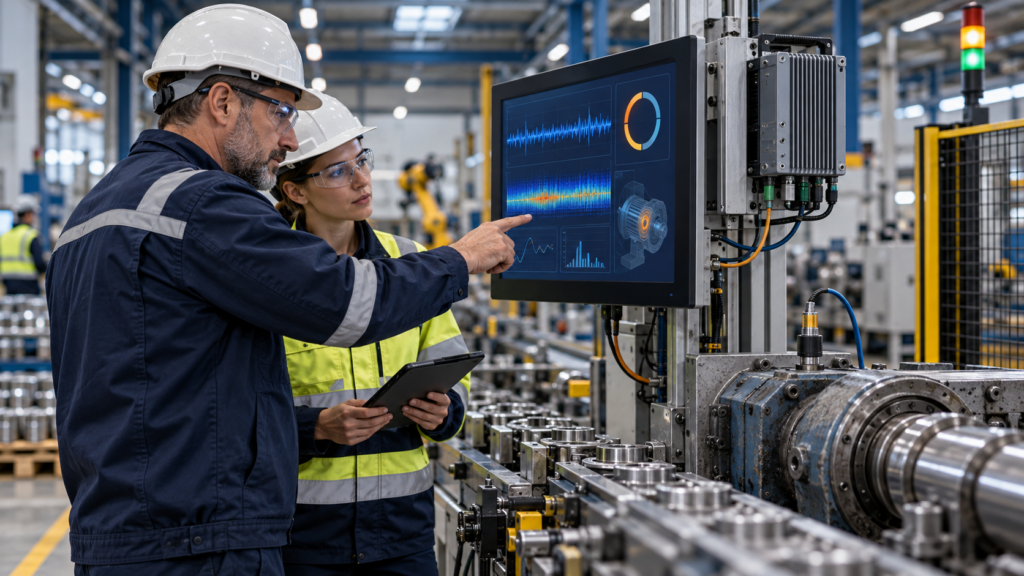
Industrial AI is moving rapidly from experimentation into production. Yet in manufacturing, value does not come from a model performing well in isolation. It comes from better decisions, more stable processes and systems that operators and engineers can actually trust.
For industrial companies, the challenge is therefore broader than selecting an algorithm. AI has to work with real machines, incomplete data, changing operating conditions and established engineering processes. It must also fit into existing automation and IT architectures.
From prediction to industrial decision-making
Many AI applications begin with a familiar pattern: collect data, train a model and generate a prediction.
That is necessary, but it is not sufficient.
In an industrial environment, the more important questions are:
— Is the underlying data trustworthy and interpretable?
— Can the model be integrated into the existing process?
— Is its output understandable to engineers and operators?
— What happens when operating conditions change?
— Who remains responsible for the resulting decision?
— Can the system be maintained over its operational lifetime?
This shifts the focus from isolated AI models to AI-enabled industrial capabilities.
Context matters
Manufacturing data rarely speaks for itself.
Sensor values gain meaning only through context: which machine produced them, under which operating conditions, for which product, using which component configuration and at what point in the lifecycle.
This is why Industrial AI is closely connected with technologies such as digital twins, Asset Administration Shells and structured lifecycle data. They provide the semantic context that allows AI systems to move beyond pattern recognition towards more reliable industrial reasoning.
For EIRAS, this connection between data architecture and intelligence is fundamental.
Human-centred AI is an engineering requirement
Industrial AI should not remove people from the decision process simply because automation is technically possible.
In many applications, the stronger approach is to combine machine intelligence with human expertise. AI can detect patterns, compare alternatives and identify anomalies, while operators and engineers contribute contextual knowledge, judgement and responsibility.
Human-centred AI therefore means designing systems in which:
— recommendations can be understood
— uncertainty is visible
— users can intervene
— responsibility remains clear
— automation supports rather than obscures operational decision-making
This is particularly important in safety-relevant, complex or rapidly changing production environments.
Trustworthiness requires more than accuracy
A model with high accuracy in a laboratory setting may still fail to create industrial value.
Trustworthy Industrial AI also requires:
— robustness under changing conditions
— traceable data and model assumptions
— transparent performance limits
— monitoring during operation
— mechanisms for detecting drift and degradation
— appropriate cybersecurity and data governance
These are not secondary compliance issues. They determine whether an AI application can be deployed and maintained in practice.
From pilot to scalable capability
One of the recurring weaknesses of industrial AI projects is that they remain isolated pilots.
A successful demonstrator is valuable, but the real challenge begins afterwards: integrating it into processes, connecting it with industrial data sources, defining ownership and creating an architecture that can be reused.
EIRAS therefore approaches Industrial AI as part of a broader transformation path:
industrial challenge → data foundation → AI capability → validated pilot → scalable deployment
The objective is not AI for its own sake, but measurable industrial improvement.
Where EIRAS focuses
Our work in Industrial AI concentrates on areas where intelligent methods can create direct operational value, including:
— anomaly detection and condition monitoring
— intelligent commissioning and optimisation
— decision support for engineering and operations
— AI-supported automation
— lifecycle and product data intelligence
— resilient production systems
— human–machine collaboration
The common principle is simple: AI should become part of the industrial system, not remain an isolated software experiment.
From models to reliable manufacturing decisions
Industrial AI will become increasingly important for competitiveness, resilience and productivity. But the companies that benefit most will not necessarily be those with the most AI models.
They will be those that combine trustworthy data, engineering knowledge, interoperable architectures and human expertise into capabilities that can be deployed repeatedly and reliably.
That is where Industrial AI moves beyond the hype — and becomes industrial infrastructure.
Interested in exploring an Industrial AI use case, pilot or roadmap? Contact EIRAS to discuss the most valuable next step.