From Requirements to Intelligent Industrial Systems
Advancing capability-based, knowledge-grounded and AI-assisted engineering of industrial systems.
Manufacturing systems must respond to changing requirements, increasing technical complexity and growing demands for flexibility and resilience. Yet translating functional needs into coherent and implementable system configurations still requires substantial engineering effort.
EIRAS investigates System-Level Generative Engineering: an approach that brings together structured requirements, machine-readable capabilities, reusable engineering knowledge and agentic AI to support the synthesis of traceable industrial system configurations.
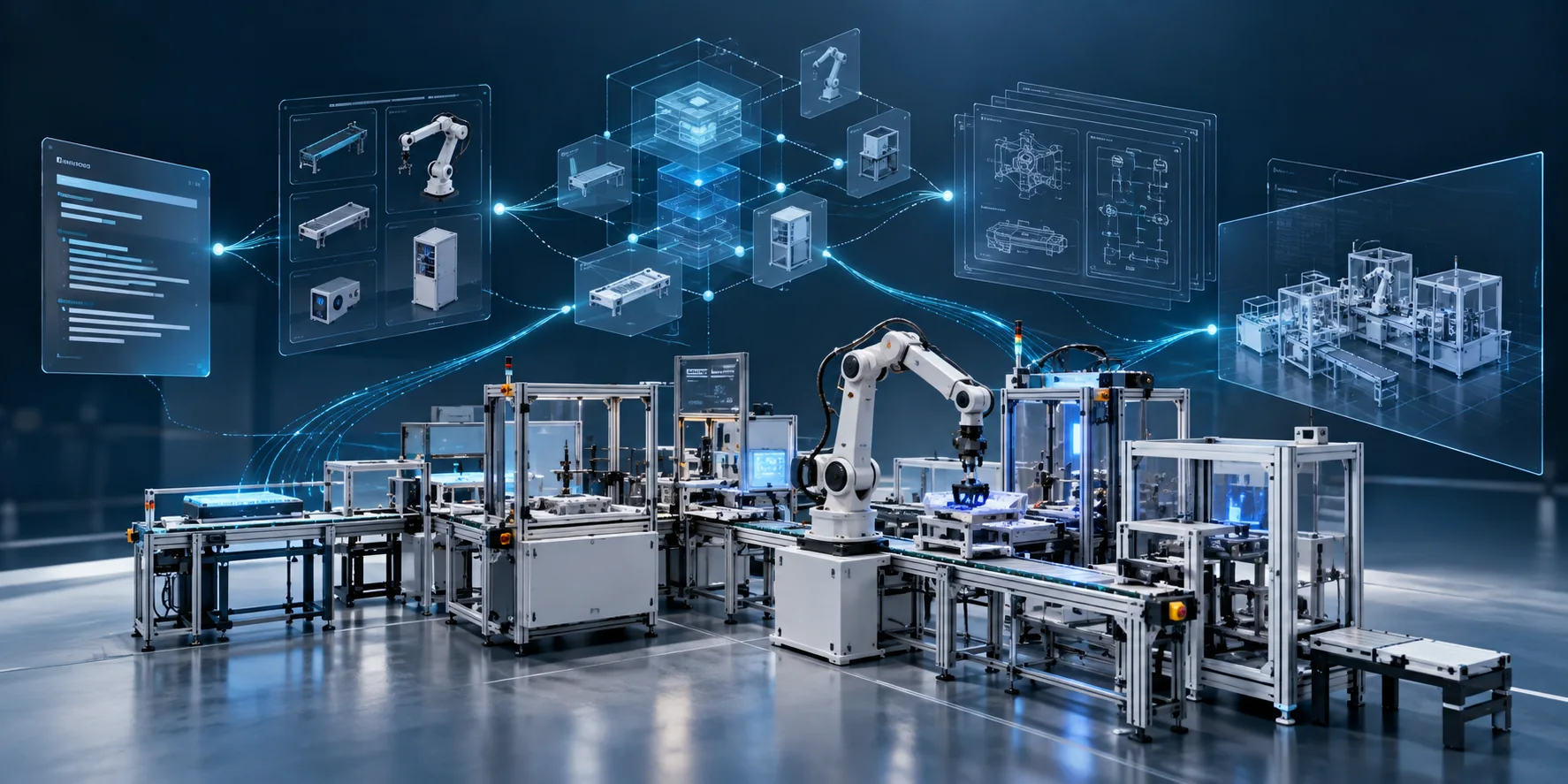
Beyond Generating Individual Components
Our research concerns the engineering of complete industrial systems — not merely the generative design of individual parts or the automated production of engineering documents.
Capabilities
Assets and resources are described by their functions and technical properties, with Asset Administration Shells (AAS) as an important source of structured information.
Engineering Knowledge
Existing configurations and implementation precedents provide practical knowledge about how resources can be instantiated, arranged and interconnected.
Agentic Synthesis
AI-assisted workflows combine requirements, resource descriptions, constraints and reference solutions into traceable candidates for system configurations.
From Engineering Intent to Verified Configurations
Our long-term vision is a closed-loop engineering process. The current CRAFT-AI prototype investigates early stages of this framework: grounding, matching, synthesis and structural assurance. Simulation-based operational verification and learning from feedback remain part of the research agenda.
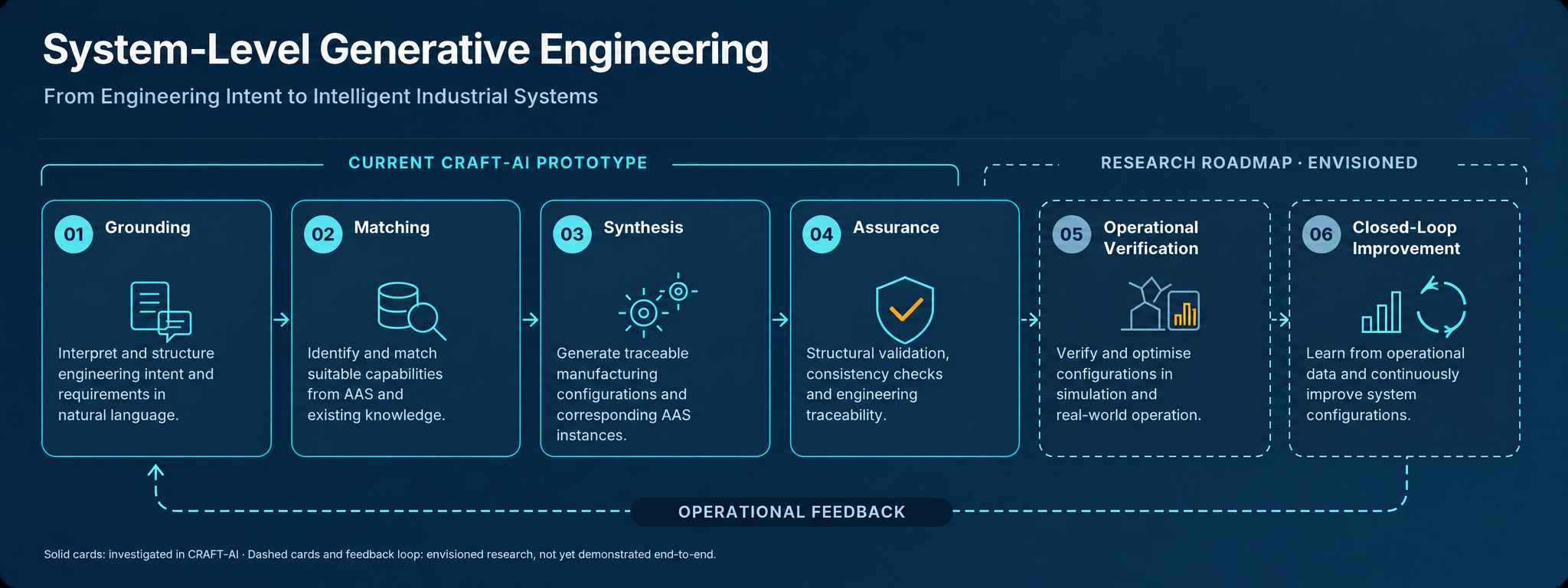
Research status: The diagram distinguishes demonstrated functions from envisioned capabilities. Structural checks do not establish successful runtime operation or automated self-improvement.
CRAFT-AI: Engineering from Requirements and Capabilities
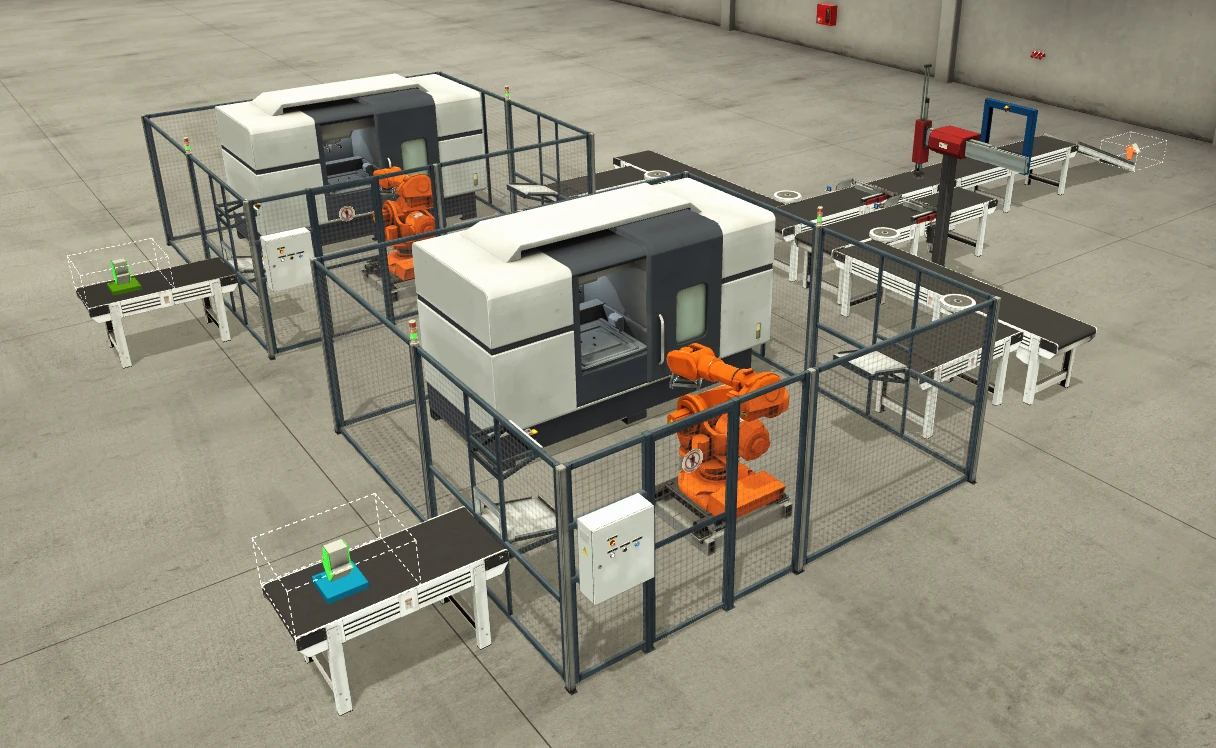
CRAFT-AI (Capability and Requirement Alignment for Flexible Manufacturing through Agentic AI) is a research prototype developed at EIRAS. It translates natural-language manufacturing tasks into Factory I/O scene configurations and associated AAS instances.
Its agent combines descriptions of available resource capabilities with implementation knowledge from previously created reference scenes. This helps identify which components are plausible in a requested configuration — and which cannot be supported by the available evidence.
In one multi-stage assembly example, the prototype generated a candidate configuration with traceable relationships between requirements, selected components and reusable reference implementations.
Important limitation: Structural consistency was checked, but operational functionality has not yet been demonstrated by the reported tests.
What Comes Next
Verification and Assurance
Investigating simulation, operational testing and engineering constraints to evaluate generated solutions beyond structural correctness.
Knowledge-driven Reconfiguration
Extending capability-based engineering to more diverse resources, changing requirements and heterogeneous industrial scenarios.
Learning Engineering Processes
Exploring how validation results, engineering decisions and operational feedback can improve future system configurations.
Advance Generative Engineering with EIRAS
EIRAS welcomes collaboration with industrial companies, universities and research organisations on research methods, reference architectures, demonstrators and industrial validation scenarios.
Discuss a collaboration